Honoring Keri Roberts’ Legacy of Animal and Human Welfare in Windham County
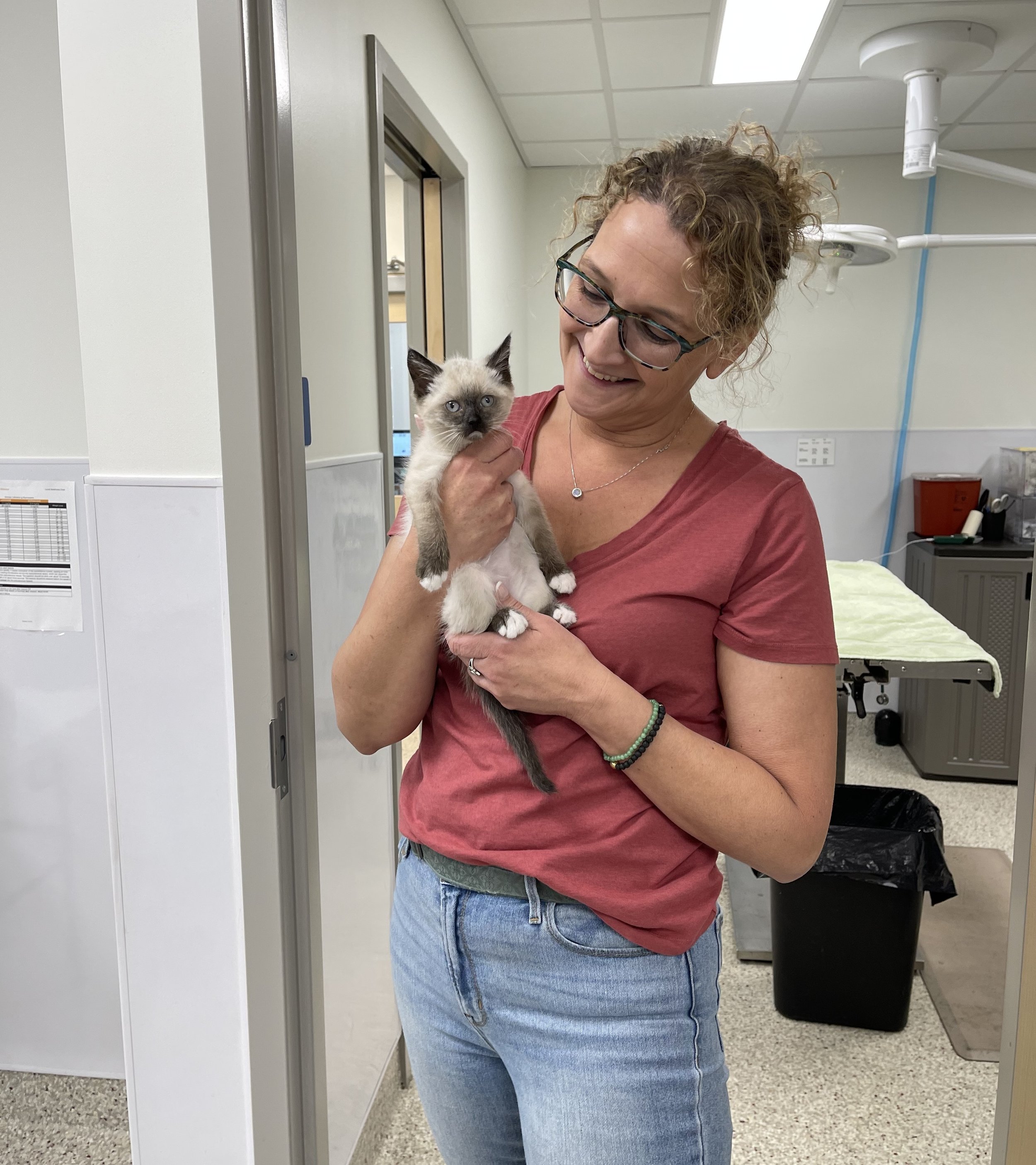
Keri Roberts knows it takes our whole community to ensure animal welfare, and she’s dedicated 23 years of her career to transforming WCHS into an organization that works alongside our community members to find the best outcomes for both animals and people.
Keri, our Director of Operations, is transitioning to her next professional adventure at the Brattleboro Veterinary Clinic. We’re celebrating her legacy and impact on WCHS, and know she will continue to accomplish incredible things.
We sat down with Keri and talked with her about how WCHS has transformed into a proactive community resource, her proudest moments, animals who will remain in her heart forever, and what’s coming up next.
This is also a story about WCHS evolution as an organization, shepherded by Keri’s leadership and vision.
-
When I first started, WCHS was viewed more as an animal control organization than a partner to people who own animals. We did not have any programs to help people who were in trouble.
We are now an inclusive organization. We are part of the community and we strive to support people to help them keep their animals in their homes.
That shift happened over time with different boards of directors and management, and it stemmed from more knowledge about trends in animal welfare, community outreach, and training for staff.
-
Yes, it was clear to me early on. I remember one of the first cases that we dealt with was a hoarding case for greyhounds. They were living in a barn, retired from the racetrack, in an inhumane situation. I remember thinking that the set up wasn't bad, the owner had the right idea, her heart was in the right place, she just did not have the knowledge or resources to be able to care for the greyhounds the way they were supposed to be cared for.
In a lot of the hoarding cases I’ve dealt with, the people have the right general idea and big hearts, but they don't have the knowledge or the resources. We have to remember people are just people. I don’t think they have evil intent, they are just trying to help. It’s all about having too much heart and not enough resources. No knowing where to go to look for help, and being afraid of the judgement that might come when they do. Success for the animals looks like working with people as a team to find the right solution.
Another case was a woman with many cats in Putney. She was very guarded on the phone, but when I visited the property with a police officer, I noticed that a nursing mama cat had been spayed. The more we talked, I realized what she really needed was resources for spay and neuter, vaccines and preventatives, and help placing kittens into loving homes.
That was around the time Dr. Sue Kelly joined the organization. We decided that we couldn’t take in 90 cats, but we could help her with spay/neuter, rehoming babies, and providing food and basic vet care.
Amazingly, she was one of our first spay/neuter pilot programs. We did over 100 spay/neuter surgeries and took in just about as many kittens, but it happened over a 3 year period of time. This meant no strain on the shelter or the staff, and the owner trusted we were here to help. She would give treatments at home, and reach out when she needed assistance. The cats were happier, more well adjusted, and we helped stop the overpopulation by spaying and neutering.
-
Definitely the PCA (Pet Care Assistance) program. It took a long time to build it, and it’s amazing to see it expand to a whole wellness center serving thousands of pets annually.
My long-term vision was to help people who love their animals to keep them. We had animals surrendered for a flea infestation or an upper respiratory infection, when flea treatment or antibiotics could solve the problem and the animals could stay in their home. People needed our help, not our judgement.
Spay/neuter was a gamechanger–not only for feral cat populations but for lower income people in our community.
In the early days of our PCA program, we got a grant from Banfield to run a pilot program to provide free spay/neuter, vaccines, preventatives, food and follow up care. At first, it was really hard to get people to come to us, because there was still fear about how we would perceive or judge them.
I got 10 people to participate in the program–they all had multiple animals. We started seeing them, they started telling people. It really spread by word of mouth.
That program spiraled and grew over the years into something a lot bigger. We are the first shelter in VT to have a program like this.
Changing from a closed-minded to an open-minded adoption process is another huge one.
I did a lot of research on big city shelters euthanizing hundreds of animals a day. I learned this was happening because they couldn’t place them in homes fast enough due to all the conditions adopters needed to meet, and they ran out of room and resources.
Open-minded adoption without applications and onerous requirements for adopters changed things for animals big time. We can get them adopted much faster, which means we can help even more animals.
We began doing fee-waived adoption events with national partners like Subaru of America, who offered grants to offset the loss of adoption revenue.
There is a lot of stigma and thinking that free animals won’t be valued, but that’s not the right way to think about it. We have to close off judgement about a person’s circumstances. People will acquire animals regardless of whether they come from us, but animals from our shelter have been spayed/neutered, vaccinated, and treated with heartworm and flea and tick preventatives. All they have to do is maintain, and 90% of the time, animals stay with their adopters.
If a person is unhoused and they want to adopt a dog, we have to think about whether this dog would be better off alone in a kennel, or with someone who loves them, and makes sure they get fed before themselves. If I had a choice, I would choose to have a human companion who loved me rather than sitting in a kennel alone.
Plus, we’ll continue to offer help after adoption. We are a resource to them.
-
We do collaborate on a tiny scale, on an as-needed basis, like each group taking a few animals from a large hoarding case or sharing a large donation of pet food. But it’s minimal compared to what could be done.
Before Covid, we tried to get other shelters to partner statewide and share our knowledge and outreach capacity to help even more animals. We hoped to have a committee to oversee our collaborations, but then Covid hit, and we had to put this effort on hold.
-
There are so many animals who have touched me. When I first started, I was a kennel tech. When you work hands-on with the animals, you bond with them and build relationships. The ones who are here for a long time become part of your life.
There was this one dog. A giant black lab. I found him tied to the fence outside the shelter one morning. I couldn’t get near him; he barked and growled at me. The poor thing had no idea what was going on. I knew I had to get him untied and into the yard, but had no idea how. I decided to let another dog into the play yard to see what he would do. As soon as he saw me with the other dog, his whole demeanor changed. He got wiggly, and suddenly seemed happy to see me, a completely different dog.
I was able to build enough trust to untie him from the fence that morning and get him inside. The difficult part was that he would trust no one but me. It took him a long time to build relationships with other people. He was here for close to a year, and I worried if I could ever get him adopted. Back then, we didn't have access to medications that helped with stress that we do now, so we worked hard on positive reinforcement and getting to trust us and other people.
One day, an adopter came in who had a similar kind of dog, but female. They came to meet him and patiently sat with him for at least an hour. He warmed up slowly and accepted treats from them. They brought their dog in the next day for a ‘meet and greet.’ Once he saw them with their dog, he knew he could trust them and they brought him home that day. Both dogs had their heads out the window when they drove away, it was the cutest thing. He came back to visit me over the years, and passed away 10 years later.
There have been many cats. Just this year I hand-raised a kitten, Cyprus. I realized early on he wasn’t quite right. He has cerebral hypoplasia which means he has limited motor skills. It took him forever to learn how to climb. He walks backwards. When he plays, he misses things he tries to hit. My guess is that mom knew something was wrong and abandoned him, which is how he ended up an orphan. He still has ongoing health issues, but he is my baby.
-
Some people have an innate animal sense–understanding them, their body language, how they communicate with each other and humans. It’s a different language and is not something everyone understands. If a cat is giving the staff a hard time, I say “I’ll go talk to it,” and I literally mean that. Ten minutes later, I’ll understand what they are trying to tell me. It’s an intuition you are born with. It’s not something you can train or learn.
I can see this in others by how animals react to them. One woman I mentored, Heidi definitely had animal sense. She was born with it. She could go in and turn a grumpy cat around in two seconds. She runs a clinic in Ohio now, and still comes to visit me. I’m so grateful for connections like this, and people who can truly connect with animals.
-
Focus. It’s always about what is best for the animal. It’s never about the person, it’s never about me. It’s always about the animal. That’s how I make all of my decisions.
-
Right now, I’m taking time to go back to what I enjoy most, which is working directly with animals and people at Brattleboro Veterinary Clinic. WCHS has grown and evolved. With that growth, I took on more managerial and administrative responsibilities. I am fortunate to have those learning experiences, but I realized that directly caring for animals is something I need.
Today, WCHS has amazing managers and staff, and I feel it is the right time to step away and be able to spend every day caring for animals. I am so grateful for the opportunity of a lifetime to serve at WCHS for over twenty years, and I know the organization will continue to thrive because of the role I've had in turning it into the amazing place it is today. You can reach me at keri.wchs@gmail.com if you would like to connect.